Experience
AI Intern
Early-stage perception and autonomy-stack prototyping for a Personal Rapid Transit (PRT) platform: data collection through to edge deployment, worked end to end and largely solo.
Atria University · CoE eMobility · July 2026
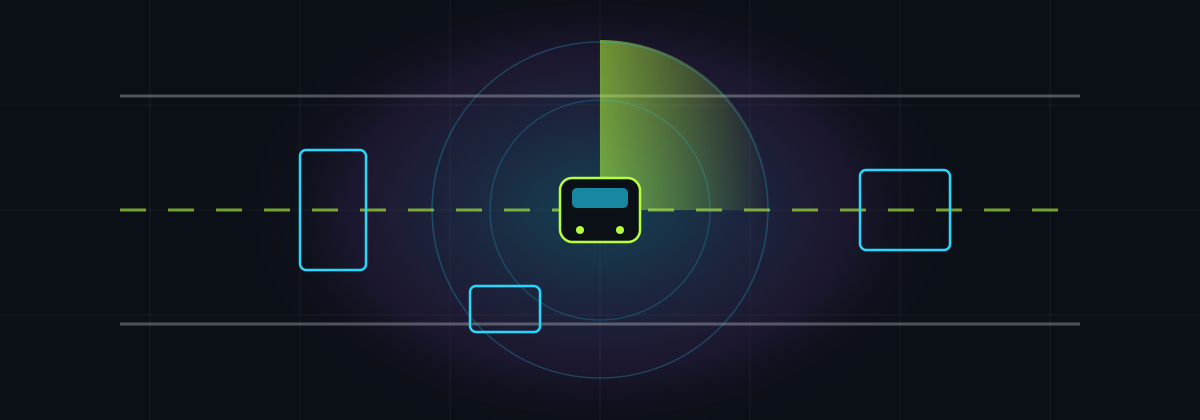
Demo footage
Short clips of the perception pipeline running (camera input with track segmentation and detected pedestrians), plus recorded track footage.
What I did
- Independently developed an early-stage perception pipeline for a Personal Rapid Transit (PRT) system, working across data collection, annotation, track segmentation, object detection and real-time perception testing.
- Built a U-Net based track-segmentation model and a YOLOv8-based detector for pedestrians and road-relevant objects, then fused their outputs into a unified perception pipeline.
- Tested the system on recorded track footage and live camera input. Segmentation was reliable on relatively straight track sections; broader robustness stayed constrained by the limited diversity of the training data.
- Extended the work toward the wider autonomy stack: installed and tested ROS 2 Humble and Autoware on an NVIDIA Jetson AGX Orin 64 GB, and explored the integration requirements for LiDAR, radar, GNSS and other sensors.
- Experimented with LingBot-Map for video-based 3D reconstruction, generating a short reconstruction locally despite GPU-memory limits, as an initial look at mapping approaches for the platform.
Technical highlights
Perception pipeline
- Collected and prepared real-world track video data.
- Converted video into training frames.
- Annotated roughly 700 to 900 frames in CVAT.
- Trained a U-Net for track segmentation.
- Trained / fine-tuned YOLOv8 for object detection.
- Fused segmentation and detection outputs into one perception pass.
Real-time evaluation
- Tested perception on live camera input and recorded track footage.
- Evaluated behaviour under real-world conditions.
- Observed strong segmentation on relatively straight track sections.
- Identified dataset diversity as the key limitation to robustness.
Autonomous mobility stack
- NVIDIA Jetson AGX Orin 64 GB as the target compute.
- ROS 2 Humble and Autoware installed and tested.
- Tried both stable and latest Autoware configurations, plus simulation.
- Explored the autonomous-vehicle software stack end to end.
- Investigated LiDAR, radar and GNSS integration requirements.
Mapping exploration
- Investigated LingBot-Map for video-based 3D reconstruction.
- Ran the pretrained pipeline locally.
- Generated a short (~3 second) reconstruction.
- Looked into GPU-memory limits and practical feasibility for the platform.
Results
- Working U-Net + YOLOv8 perception pipeline running on recorded and live track footage, with fused segmentation and detection output.
- ROS 2 Humble and Autoware brought up and tested on Jetson AGX Orin, with a first pass over sensor-integration requirements for the future platform.
- Short LingBot-Map 3D reconstruction produced locally as an initial mapping experiment.
- This is exploratory engineering and research work on an early-stage prototype, not a completed autonomous vehicle or a production deployment.
In code
seg  = unet(frame)                    # track / not-track mask
dets = yolo(frame)                    # pedestrians + road objects
track_mask = (seg.argmax(0) == TRACK)
for box, cls, conf in dets:
    on_track = track_mask[box.cy, box.cx]
    events.append(Percept(cls, conf, box, on_track))▊
Fusing the two models into one perception pass: U-Net track mask plus YOLOv8 detections.
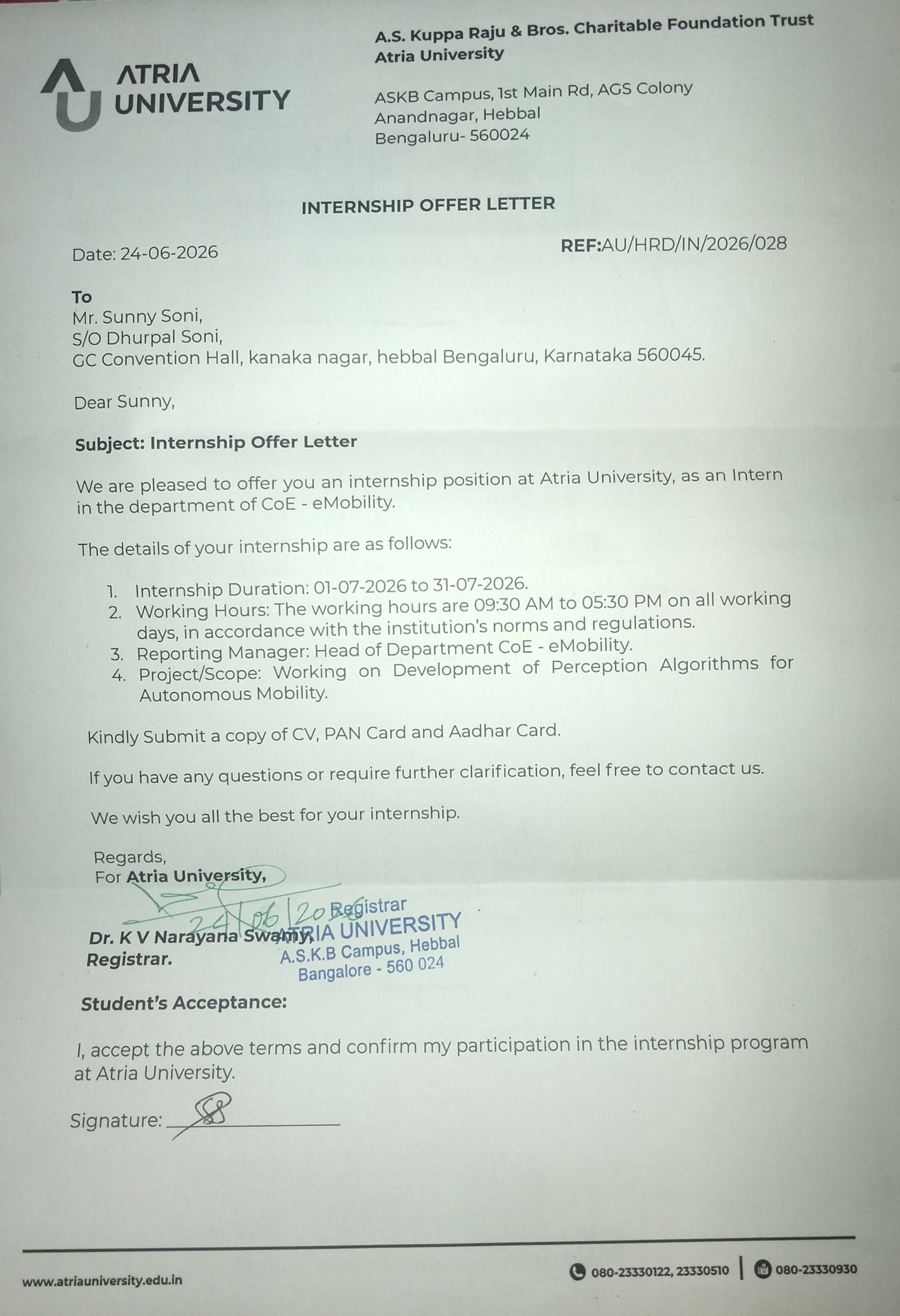
Offer letter
Kept hidden by default for privacy. Click to preview, view only.
Preview offer letter click to show
Comments
Thoughts or questions on this experience? Leave a note below.
Loading comments…